


Belt and Road Initiative: China-Benin Cooperation Focuses on Education and Innovation to Modernize Benin

Under the Belt and Road Initiative, China-Benin cooperation takes shape through initiatives such as scholarships for studies in China and awards for academic excellence. By supporting education and innovation, these programmes aim to strengthen the skills of young Beninese people and contribute to the country’s development.
Rachel Eriyomi Assinou is pursuing a master’s degree in mechanical engineering in China through a scholarship from WAPCO Benin. For this Beninese student, the experience goes beyond attending classes at a foreign institution. It is also an opportunity to acquire technical skills and discover a different working and living environment.
“Currently, I am working on pipelines […] that is, detecting leaks in pipelines, how to repair them, and developing a programme to prevent leaks when they occur again,” she explained at the WAPCO forum on 30 July 2025. Her journey is part of that of an initial cohort of around ten Beninese students sent to China to train in fields such as petroleum engineering, mechanical engineering and computer science. Behind this initiative lies an ambition that goes beyond earning a degree: to train young people capable of applying their knowledge to support economic activities in their home country.
In China, Learning a Profession While Discovering Another Culture
In China, their daily lives revolve around learning Mandarin, attending calligraphy classes, living in dormitories, discovering hot pot and visiting museums. Adapting to a new cultural environment therefore goes hand in hand with their academic studies.
For these young people, the experience extends beyond the classroom. It exposes them to different customs, learning methods and realities from those they are familiar with in Benin.
Technical training occupies a particularly important place in the programme. While visiting Benin during the July 2025 holidays, Rachel Eriyomi Assinou, a master’s student in mechanical engineering, presented work on leak detection and ways of repairing leaks. Her specialisation is directly relevant to the needs of the energy sector, where equipment management, incident prevention and maintenance are essential.
The challenge, therefore, is to connect the knowledge acquired abroad with Benin’s professional realities. This is precisely the objective set out by WAPCO, which presents training both as an investment in human capital and as support for its industrial project.
WAPCO Invests in National Skills
Jin Jinsong, WAPCO Benin’s general administrator, who attended the forum, placed the scholarship programme within the context of the company’s long-term operations.
“Our objective is to train talents who are technically competent, internationally minded and grounded in local realities, in order to ensure the smooth operation and sustainability of our project,” he said.
In his view, human resources are an essential driver of development in the energy sector.
“We are convinced that human resources are the most valuable asset of any company and that they are the key to the sustainable development of Benin’s energy sector,” he stated.
He added that this commitment must continue over time.
“In the future, we will continue to improve our training system, and we hope that you, dear students, will make the most of this opportunity. Be disciplined, curious, open-minded and committed in your studies and daily lives. Become seekers of knowledge, intercultural ambassadors and builders of social progress,” he concluded.
His ambition is closely aligned with Benin’s development objectives, particularly investment in human capital, the enhancement of productive potential and the strengthening of national skills in the energy and mining sectors.
Dine Mahma Saliou, Deputy Chief of Staff at the Ministry of Energy, Water and Mines, praised the students’ boldness, perseverance and open-mindedness. Speaking at the WAPCO forum, he also highlighted the broader significance of the company’s initiative.
“I would like to commend WAPCO’s strategic vision, which goes beyond resource extraction and embraces a model of sustainable local development, skills transfer and corporate social responsibility,” he acknowledged.
Skills transfer is central to this initiative. Beyond training a small group of students, the question is how the knowledge they acquire can be used to gradually strengthen the expertise available in Benin.
Josué Kolade Azandegbey, Deputy Chief of Staff at the Ministry of Higher Education and Scientific Research, also attended the forum. He highlighted the responsibility that comes with receiving these scholarships.
“This is an exceptional scholarship. Not simply because you are being offered optimal and ideal conditions for training and studying in China, but because you carry a strong promise that, once your studies are completed, you will return to help support our country’s economic development,” he explained.
For China, Education Is Part of a Broader Partnership
WAPCO’s presence in Benin and its training programme are part of a bilateral relationship that has gradually expanded into several areas. China’s ambassador to Benin, Zhang Wei, links this initiative to the strategic partnership established between the two countries in 2023.
“Since the establishment of the strategic partnership between the two countries in 2023, WAPCO’s establishment in Benin and, above all, the commissioning of the pipeline have been new achievements in practical cooperation between the two countries,” he said.
He then explained the rationale behind the training programme.
“Where does WAPCO’s project to train Beninese students in China come from? First, it is intended to support the country’s economic development. It is also intended to support the development of WAPCO,” he explained. On that basis, he encouraged the scholarship recipients at the same forum to see themselves as ambassadors of China in Benin.
The students thus become participants in a relationship that extends beyond institutional exchanges. By living and studying in China, they discover a society, professional practices and an academic environment that they can share when they return home. This human dimension complements economic projects and cooperation agreements.
It is also reflected in the Belt and Road Initiative, which provides a framework for exchange programmes and initiatives promoting academic excellence, including awards presented to students.
Official documents consulted by TRIOMPHE MAG help illustrate the scale of the programme. For the 2024–2025 academic year, WAPCO offered fifteen scholarships, and twelve students travelled to China. For 2025–2026, ten master’s scholarships were offered, compared with five scholarships for Benin provided by the Chinese government.
None of the announcements issued by the Directorate of Scholarships and consulted for this article contains a formal commitment requiring recipients to return to Benin. At this stage, the “strong promise” mentioned by the authorities remains a promise. The ambassador himself acknowledged that the programme also serves WAPCO’s interests. The real test will therefore be whether the students return and what they contribute beyond a single company.
Excellence Awards to Encourage Innovation
Training in China is not the only way this cooperation seeks to support Beninese talent. Another initiative is the Belt and Road Excellence Award, which recognises students for their academic achievements and projects.
At its seventh edition, held in March 2026, the initiative recognised around fifty award recipients. Special awards range from cash prizes of 500,000 CFA francs to the opportunity to pursue a master’s degree at a Chinese university. Since its launch in 2019, nearly 350 students have benefited from the initiative, with total funding amounting to approximately 158 million CFA francs.
At the seventh award ceremony, held in Cotonou on 18 March 2026, one of the 2026 recipients was Roland Gbohoui, who holds a professional bachelor’s degree in motor vehicle equipment. He received the Best Innovation Award for a three-wheeled electric scooter project.
“It is an ultra-lightweight electric scooter with a long range and one distinctive feature: regenerative technology. That is what earned me the Best Innovation Award,” he explained.
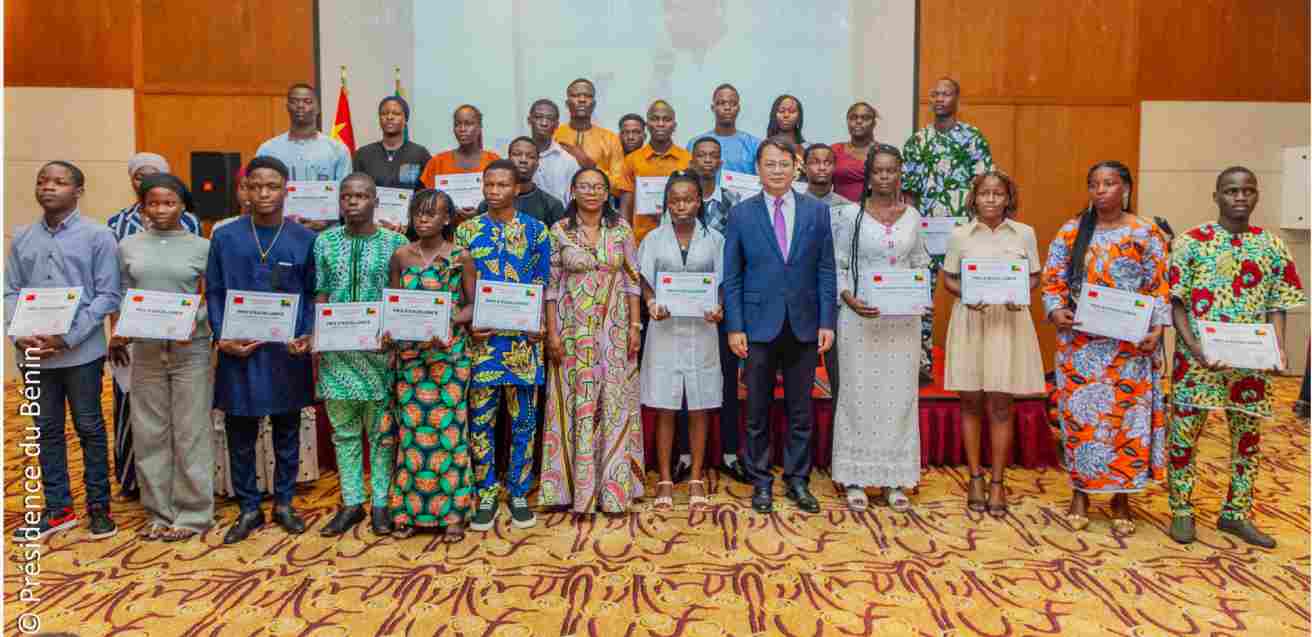
Around fifty students were recognised at the seventh edition of the Belt and Road Excellence Awards, held in Cotonou on 18 March 2026. Photo: Presidency of Benin.
The significance of this distinction lies in the emphasis it places on ingenuity. Roland Gbohoui’s project demonstrates that the awards are not limited to academic performance but can also highlight solutions developed by young professionals.
For Zhang Wei, China’s ambassador to Benin, the initiative reflects an ambition that goes beyond the presentation of awards.
“The Belt and Road Initiative proposed by President Xi Jinping is a Chinese solution to addressing the challenges of our time, promoting global development and achieving shared prosperity,” he said at the award ceremony.
Recognising the responsibility that comes with the distinction, award recipient Fantasia Mahinou made a firm commitment.
“We hereby pledge to make good use of the prizes awarded to us and to continue working with diligence and determination so that we can contribute to the development of our country,” the student promised.
From 1964 to Today: A Relationship That Has Evolved
Current China-Benin cooperation builds on several decades of diplomatic history. Benin, then known as Dahomey, established diplomatic relations with the People’s Republic of China on 12 November 1964. Relations were severed in January 1966 before being restored on 29 December 1972.
Since then, bilateral relations have expanded into various fields, including economic cooperation, university exchanges and cultural initiatives. The strategic partnership established in 2023 marked a new stage in this relationship. Industrial projects, scholarship programmes and academic excellence awards are among its current manifestations.
Rachel Eriyomi Assinou’s training in mechanical engineering and Roland Gbohoui’s electric scooter project highlight two key aspects of China-Benin cooperation: developing technical skills and encouraging innovation.
Through scholarships and excellence awards, this cooperation offers young Beninese people opportunities for education and recognition of their projects. The challenge for Benin is to ensure that these opportunities translate into skills that benefit its industries and innovations capable of meeting the country’s needs.
